Final Interview with ALCHIMIA Coordinator
We are delighted to share the final interview with Carmen Perea Escribiano, Coordinator of the ALCHIMIA project. Over the past few years, ALCHIMIA has been at the forefront of developing advanced AI solutions for industrial manufacturing, particularly in the metallurgy sector. The project focused on creating a custom Federated Learning framework, combined with Continual and Transfer Learning, to address key challenges in industrial data management, process optimization, and predictive quality control.
In this interview, Carmen reflects on the project’s main innovations, the crucial role of industrial partners, the challenges the consortium faced, and the broader collaborative and sustainability impacts that make ALCHIMIA a unique example of research and innovation working hand-in-hand with industry.
Q: What are the main innovations developed within ALCHIMIA?
Carmen: The innovations in ALCHIMIA are quite broad and cover a lot of ground. For example, we developed a platform for Federated, Continual, and Transfer Learning, a dynamic process model for monitoring and controlling the Electric Arc Furnace, and tools for scrap characterization and optimization. We also created an Industry 5.0 Toolkit for human-centric technology development, an adaptable and scalable data transformation process for large-scale use, ladle furnace modelling and optimization to improve quality and sustainability, and methods for predicting and classifying defects in the foundry process.
On top of that, we applied the IAM4SDG methodology to evaluate sustainability impacts. You can find more about these results in our ALCHIMIA project videos.
Q: What role did industrial partners play in validating these technologies?
Carmen: Industrial partners and end users were central to everything we did. They were involved from the very beginning: helping define requirements, continuously providing data and feedback during development, and supporting final validation and demonstration. Their involvement was crucial, and really made industry engagement a core pillar of the project.
Q: How do you see ALCHIMIA’s solutions being adopted in real industrial environments?
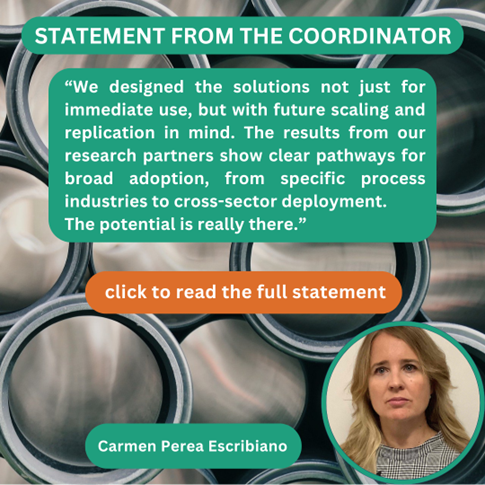
Carmen: We designed the solutions not just for immediate use, but with future scaling and replication in mind. The results from our research partners show clear pathways for broad adoption, from specific process industries to cross-sector deployment. The potential is really there.
Q: Looking back, what were the main challenges you faced, and how did the consortium overcome them?
Carmen: One of the biggest challenges was data availability, which is a common issue in AI projects. The data needs to be sufficient in both quantity and quality, and collecting, curating, and sharing it required a lot of effort from our partners and users. It wasn’t easy, but their commitment made it possible to develop and validate our models.
Q: What has been the most meaningful human or collaborative impact of ALCHIMIA for you and the consortium?
Carmen: Using the IAM4SDG methodology, we identified 21 opportunities for positive SDG impact: 6 high, 11 medium, and 4 low. The top SDGs were Responsible Consumption and Production (12), Decent Work and Economic Growth (8), and Industry, Innovation and Infrastructure (9). This really shows that our results can be transferred and adapted to other domains, creating impact beyond the original project scope.